The Little Girl Held the Stranger Biker’s Hand and Said, “Mom Says the Man in This Photo Is My Grandfather.”83

**Title: The Little Girl Held the Stranger Biker’s Hand and Said, “Mom Says the Man in This Photo Is My Grandfather.”**
The biker rally had taken over the small town for the weekend. Main Street was lined with motorcycles of every size and color—chrome gleaming under the summer sun, engines rumbling like distant thunder. The air smelled of gasoline and barbecue and the faint sweetness of cotton candy from a vendor’s cart.
Mia had never seen anything like it. She was seven years old, with pigtails and a missing front tooth and eyes that took in everything. She held her mother’s hand tightly as they walked through the crowd, weaving between leather jackets and bandanas and boots that came up to her knees.
Then she saw the patch.
It was stitched onto the back of a weathered leather vest—a blue bird in flight, its wings spread wide. The same blue bird that was painted on the wooden box in her mother’s closet. The same blue bird that appeared in the photograph her mother kept on the mantelpiece.
Mia stopped walking.
She looked up at the man wearing the vest. He was older, with grey hair pulled back in a ponytail and a beard that needed trimming. His face was lined and weathered, but his eyes were kind.
She let go of her mother’s hand.
She walked toward him.
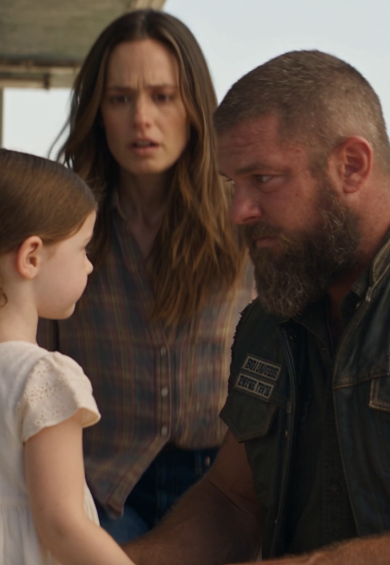
She reached up and grabbed his hand.
The man looked down, surprised. His eyes widened when he saw the photograph she pulled from her pocket—a photograph she had taken from the mantelpiece that morning without asking.
“Mom says the man in this photo is my grandfather,” Mia said.
—
**The Recognition**
Anna rushed through the crowd, her heart pounding. She had only looked away for a second. She had only stopped to buy a bottle of water. And now her daughter was holding hands with a stranger.
“Monica!” she called, using the childhood nickname she had not spoken in years. “Monica, wait!”
The man looked up. His eyes met hers. And for a moment, the world stopped.
He knew her. She knew him. The years fell away like autumn leaves, revealing something raw and tender beneath.
“Anna?” he whispered.
She froze. Her mouth opened. No words came out.
The man knelt down, still holding Mia’s hand. He looked at the photograph again. The man in the picture was younger, but he was wearing the same vest. The same blue bird patch. The same kind eyes.
“I thought you didn’t want to hear from me anymore,” he said.
Anna’s voice was barely a whisper. “They told me you never wrote.”
—
**The Letters**
Mia reached into her pocket and pulled out an envelope. It was old, creased, and yellowed at the edges. She handed it to her grandfather.
“Found it in the box,” she said. “In the closet.”
The man opened the envelope. Inside was a letter he had written twenty years ago. A letter that had been returned to him. A letter he had kept all this time.
“I thought you didn’t want to hear from me,” he repeated.
Anna shook her head. “They told me you never wrote. They told me you didn’t care. They told me—”
She stopped. She looked at the return address on the envelope. It was the home of her aunt—the relative she had stayed with after her parents separated. The aunt who had raised her while her mother worked. The aunt who had told her that her father had abandoned them.
The aunt who had kept the letters.
“She kept them,” Anna said. “She kept all of them. She told me you never wrote. She told me you had moved on. She told me—”
Her voice broke.
Her father stood up. He did not try to hug her. He did not try to fix anything. He simply stood there, holding the letter, waiting.
—
**The Truth**
They sat on a bench at the edge of the rally, away from the noise and the crowd. Mia played with a small toy on the ground. Anna and her father talked.
His name was Robert. He had been a long-haul trucker for most of his life. He had married young, had Anna young, and had divorced her mother when Anna was ten. He had not wanted the divorce. He had fought it. But the courts had ruled against him, and he had been given limited visitation.
He had written every week. He had called every Sunday. But the calls stopped connecting, and the letters stopped arriving. He had assumed Anna had moved on. He had assumed she did not want to see him.
He had kept every returned envelope. He had kept every unopened letter. He had kept the photograph of Anna as a baby, the one he still carried in his wallet.
“I never stopped loving you,” he said. “I never stopped trying.”
Anna wiped her eyes. “I thought you did. I thought you forgot about me.”
“I never forgot.”
—
**The Aunt’s Lie**
Anna’s aunt, her mother’s sister, had raised her after the divorce. She had been kind in many ways. She had provided food and shelter. She had helped with homework and attended parent-teacher conferences.
But she had also lied.
She had intercepted Robert’s letters. She had told Anna that her father had stopped writing. She had told Anna that he had moved on with a new family. She had told Anna that he did not want to see her.
She had done it because she believed she was protecting Anna. She had done it because she believed Robert was a bad influence. She had done it because she thought she knew what was best.
She had not asked Anna what she wanted. She had not given Anna a choice.
—
**The Years Lost**
Anna had grown up believing her father had abandoned her. She had carried that wound for years—through high school, through college, through her marriage, through the birth of her daughter. She had told herself that she did not need him. She had told herself that she was better off without him.
But she had never stopped wondering. She had never stopped looking at the photograph on the mantelpiece. She had never stopped hoping.
And now, here he was. Older. Weathered. Still wearing the same vest. Still carrying the same photograph.
“I don’t know what to say,” Anna admitted. “I don’t know how to start.”
Robert nodded. “We don’t have to figure it all out today. We can start with a meal. We can start with a conversation. We can start with whatever you want.”
—
**The New Beginning**
Mia looked up from her toy. “Can I call you Grandpa?”
Robert looked at Anna before answering. She nodded.
He smiled—a real smile, the kind that crinkled his eyes and softened his face. “I would like that very much.”
Mia climbed onto his lap. She showed him her toy. She told him about her school and her friends and her favorite color. She asked him about his motorcycle. She asked him about the blue bird patch.
“It’s a hawk,” he said. “Your grandmother embroidered it for me. Before you were born. Before your mom was born. It’s been on every vest I’ve ever owned.”
Mia touched the patch. “It’s pretty.”
“Your grandmother was pretty,” Robert said. “You look like her.”
Anna watched them together—her daughter and her father, sitting on a bench at a biker rally, talking about a woman neither of them had ever met. She felt something loosen in her chest. Something she had been holding onto for twenty years.
She sat down beside them.
“Tell me about her,” she said. “Tell me about Grandma.”
Robert smiled. And he began to talk.
—
**The Photograph**
Later that evening, after the rally had ended and the motorcycles had roared away, Anna took out the old photograph. It showed her father as a young man, standing beside a woman with dark hair and kind eyes. The woman was wearing the same blue bird patch on her jacket.
Anna had seen the photograph a hundred times. But she had never known who the woman was. She had never known her name. She had never known her story.
“Your grandmother’s name was Maria,” Robert said. “She was a seamstress. She made the patch herself. She loved birds. She loved the way they could fly anywhere they wanted.”
“She died when I was young,” Anna said.
“She died when you were two,” Robert said. “You don’t remember her. But she loved you. She loved you more than anything.”
Anna looked at the photograph again. Then she placed it beside a new photograph—one she had taken that afternoon of the three of them: herself, her father, and Mia.
“I want to put this on the mantelpiece,” she said.
“Both of them?”
“Both of them.”
—
**The Question**
How many relationships are destroyed by someone who claims to be protecting you?
Anna’s aunt believed she was protecting Anna. She believed she was preventing more pain. She believed she was doing the right thing.
But she was not protecting Anna. She was controlling her. She was deciding who Anna was allowed to love, who Anna was allowed to hear from, who Anna was allowed to miss.
And she did it for years. She did it in silence. She did it without ever asking Anna what she wanted.
—
**The Lesson**
Never let someone else decide who your family is. Never let a third party stand between you and the people you love.
Call them yourself. Write to them yourself. Deliver the message yourself.
Because a messenger can lie. A messenger can interfere. A messenger can destroy a relationship that was never actually broken.
Anna and her father found their way back. But they could have found it years earlier—if someone had not stood in the middle and told them it was over.
And Mia found a grandfather. She found him because she noticed a patch. She found him because she held his hand. She found him because she asked a question.
Because sometimes the only thing standing between a lost relationship and a found one is a little girl who refuses to let go.