The File Said He Had No Family—But the Bear in the Biker’s Hands Told a Different Story.84

**Title: The File Said He Had No Family—But the Bear in the Biker’s Hands Told a Different Story**
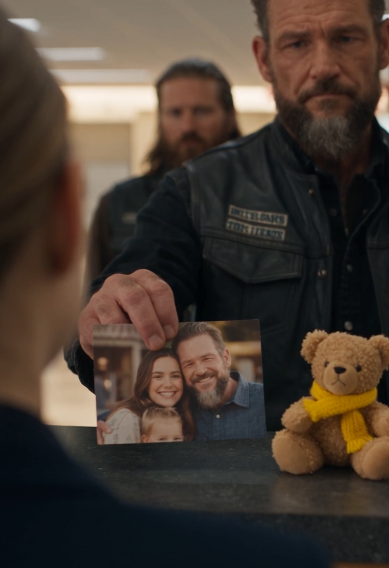
The hospital waiting room was quiet in the way that hospitals always are—fluorescent lights humming, chairs bolted to the floor, the faint smell of antiseptic and old coffee. A man in a leather vest walked up to the reception desk and set a small teddy bear on the counter. The bear was worn, its fur matted from years of hugging, and it wore a yellow scarf tied carefully around its neck.
“He promised to bring it home,” the man said to the receptionist.
Two other men stood behind him, their leather jackets creased, their faces tired. They did not sit down. They did not pace. They just stood there, waiting for news about the security guard they had been looking for.
The receptionist, a young woman named Dana, looked at the bear. Then she looked at the men. Then she looked at her computer screen.
“I’m sorry,” she said. “We don’t have any emergency contact listed for him. The system shows he has no family.”
The man in the vest—his name was Marcus—shook his head. “That’s not right. He has a daughter. He talks about her all the time.”
Dana typed a few more keys. She frowned. “There’s nothing here. No next of kin. No emergency contact. Just his name and his employment information.”
Marcus picked up the bear and held it against his chest. “He was supposed to give this to his granddaughter. Today is her birthday. He was going to leave early to be there.”
—
**The Man in the Bed**
Henry had been a security guard at the hospital for twelve years. He was sixty-three years old, with grey hair and a quiet manner and a habit of carrying candy in his pocket for the children in the pediatric ward. He had worked the night shift for most of those years—the quiet hours, the hours when the hallways were empty and the only sound was the hum of the machines.
He had collapsed during his shift. One moment he was walking his usual rounds, checking doors and signing logs. The next, he was on the floor, his chest tight, his vision swimming. A nurse found him and called for help. He had been rushed to the emergency room and then admitted to the cardiac unit.
He had been unconscious for hours. When he woke, he was groggy and disoriented. He did not know where he was. He did not know what day it was. He only knew that he was supposed to be somewhere else.
He was supposed to be at his granddaughter’s birthday party.
—
**The Bikers**
Marcus and his friends had met Henry six months earlier. They had been riding through town and had stopped at a diner for lunch. When they came out, they found Henry standing beside their motorcycles, watching them.
“Nice bikes,” he had said. “I used to ride when I was younger.”
They had started talking. Henry told them about his old Harley, the one he had sold when his daughter was born. He told them about his wife, who had passed away ten years ago. He told them about his daughter, who lived three hours away and visited when she could. He told them about his granddaughter, who was turning seven next month.
Marcus had liked him immediately. There was something genuine about Henry—something honest and unpretentious. He was not trying to impress anyone. He was just being himself.
They had exchanged numbers. They had stayed in touch. Henry had helped them find parking when they came through town. They had brought him coffee on cold nights. It was a small friendship, but it was real.
When Marcus heard that Henry had collapsed at work, he had dropped everything. He had called the other two—Danny and Chris—and they had ridden straight to the hospital.
—
**The Bear**
The bear had been in Henry’s locker at the hospital. He had bought it weeks earlier, when he saw it in the gift shop. It was soft and brown and wore a yellow scarf. It reminded him of the bear his daughter had carried everywhere when she was little.
He had wrapped it in tissue paper and hidden it in his locker, planning to give it to his granddaughter on her birthday. He had told Marcus about it, laughing at himself for being so sentimental.
“I’m going to give it to her tonight,” he had said. “She’s going to love it.”
But he had collapsed before he could leave. The bear had stayed in the locker, wrapped in tissue paper, waiting.
Marcus had found it when he went to the hospital to check on Henry. He had asked the staff if he could retrieve Henry’s belongings. They had given him the bear and a few other items—a wallet, a set of keys, a photograph.
The photograph was of a young woman and a baby. Marcus recognized the woman. She was Henry’s daughter. He had seen the photograph before, in Henry’s locker, when Henry had shown it to him with pride.
—
**The Search**
Marcus had tried to call Henry’s daughter. He had tried the number in Henry’s phone, but it was locked. He had tried the number in Henry’s wallet, but it was old and disconnected. He had tried everything he could think of.
That was when he decided to go to the hospital. He walked up to the reception desk and set the bear down.
“He promised to bring it home,” Marcus said.
Dana looked at the bear. She looked at the men. She looked at her screen again.
“I’m sorry,” she said. “We don’t have any emergency contact listed.”
—
**The Janitor**
An older woman in a housekeeping uniform was walking past the reception desk. She was pushing a cart of cleaning supplies, her eyes on the floor. She glanced at the bear, then at the photograph Marcus was holding.
She stopped.
“I know that man,” she said. “He asked me to call his daughter. He gave me the number. I took it to the office.”
Dana looked up. “When was this?”
“Last month. He said he wanted to make sure someone knew how to reach her. He said he didn’t want to be alone if something happened.”
Dana opened the paper file—the backup file, the one that was supposed to contain everything the computer system did not. She flipped through the pages. Near the back, clipped to a discharge summary, was a small slip of paper.
A phone number.
She picked up the phone and dialed.
—
**The Call**
The woman who answered was breathless, as if she had been running.
“Hello?”
“Hi, this is Dana from Mercy General Hospital. I’m calling about Henry Coleman. Are you his daughter?”
There was a pause. Then a sob.
“I’ve been waiting for someone to tell me where my father is. I’ve been calling everywhere. I didn’t know what happened to him.”
Dana’s voice softened. “He’s here. He’s recovering. He had a cardiac episode during his shift, but he’s stable now.”
“Can I see him?”
“Of course. I’ll give you the information.”
The woman—her name was Sarah—wrote down everything. She thanked Dana three times. She hung up and immediately started packing a bag.
—
**The Reunion**
Sarah arrived at the hospital three hours later. She had driven straight from work, still in her scrubs, her hair pulled back in a messy ponytail. She walked into the cardiac unit and found her father’s room.
Henry was sitting up in bed. He looked tired and pale, but he was awake. He was watching the door.
When he saw her, his face changed. His eyes filled with tears. His mouth opened, but no words came out.
Sarah crossed the room and took his hand.
“I’m here,” she said. “I’m here.”
Henry squeezed her hand. “I’m sorry,” he whispered. “I’m sorry I didn’t call. I’m sorry I didn’t—”
“Stop,” Sarah said. “You don’t have to apologize. You’re here. That’s all that matters.”
—
**The Bear**
Marcus appeared in the doorway. He was holding the bear—the one with the yellow scarf, the one Henry had bought for his granddaughter.
“I think this belongs to you,” Marcus said.
Henry looked at the bear. He looked at Sarah. He looked at Marcus.
“I was going to give it to her tonight,” he said. “It’s her birthday.”
Sarah took the bear. She held it against her chest.
“She’s here,” Sarah said. “She’s in the waiting room with my husband. She’s been asking about you all day.”
Henry closed his eyes. Tears rolled down his cheeks.
“I want to see her,” he said. “I want to give her the bear.”
Sarah nodded. She turned to Marcus. “Can you bring her in?”
Marcus nodded. He disappeared down the hallway. A moment later, he returned with a little girl. She was seven years old, with pigtails and a missing front tooth. She was holding her mother’s hand.
She looked at the man in the bed.
“Grandpa?”
Henry smiled. “Hi, sweetheart.”
She climbed onto the bed and hugged him. He held her tight.
“I got you something,” he said. He nodded toward the bear.
Sarah handed it to her daughter.
The little girl’s eyes widened. “It has a yellow scarf! Just like you said!”
Henry laughed. “I told you I would bring it home.”
—
**The Photograph**
Marcus took a photograph. It was not a professional photograph. It was just a quick shot on his phone—the little girl holding the bear, Henry holding the little girl, Sarah holding Henry’s hand. It was a photograph of a family.
He sent it to the group chat. Danny and Chris responded with heart emojis. They were still in the hallway, waiting.
Marcus walked out to join them.
“He’s okay,” he said. “He’s with his family.”
They nodded. They did not say anything. They did not have to.
They had done what they came to do. They had brought the bear home.
—
**The Lesson**
Never assume that a file tells the whole story. Never assume that a system knows everything. Never assume that someone who appears to have no family is truly alone.
Henry had a family. He had a daughter and a granddaughter and a photograph in his wallet. But the hospital’s system did not know that. The system only knew what had been entered—and what had been entered was incomplete.
A janitor remembered a conversation. A receptionist found a slip of paper. A biker brought a bear. And a family was reunited.
Because sometimes the most important information is not in the system. Sometimes it is in the hands of a stranger who cared enough to ask.