The Nurse Dropped the File When She Saw the Patient’s Surname—And the Daughter Demanded to Know What Was Being Hidden.88

**Title: **
The hospital room was quiet except for the soft beeping of the heart monitor and the distant hum of the fluorescent lights. Sarah sat beside her mother’s bed, holding her hand, watching the gentle rise and fall of her chest. Her mother, Elena, had been admitted three days ago for what the doctors called “complications from a chronic condition.” Sarah did not know what that meant exactly. She only knew that her mother was tired, and pale, and not herself.
A nurse entered the room—a young woman with dark hair pulled back in a ponytail and kind eyes. She was carrying a folder, the kind that held medical records and test results and all the information that families were not supposed to see. She smiled at Sarah, then looked down at the file.
And then she dropped it.
The folder slipped from her hands and hit the floor with a sharp slap. Papers scattered across the linoleum. The nurse knelt down quickly, her face flushed, and began gathering them up.
But Sarah had already seen.
She had seen the nurse’s expression change—the way her eyes widened, the way her hands trembled, the way she looked at the file as if it contained something dangerous.
“What is it?” Sarah asked.
The nurse shook her head. “Nothing. I’m sorry. I’m just clumsy.”
“That’s not nothing. What did you see?”
“It’s nothing. Really.”
Sarah stood up. She walked to the nurse and looked down at the papers in her hands. One of them was a form—an emergency contact form. It listed a name that Sarah had never seen before.
Thomas.
“Who is Thomas?” Sarah asked.
The nurse looked at her. Then she looked at Elena, who had opened her eyes and was watching them both.
“Please,” Sarah said. “Who is Thomas?”
—
**The Mother’s Silence**
Elena sat up in bed. Her face was pale, but her voice was steady.
“Leave it, Sarah.”
“Who is Thomas?”
“He’s no one. He’s—he’s not part of our lives.”
“He’s listed as your emergency contact. He’s the person the hospital is supposed to call if something happens to you. Why have I never heard of him?”
Elena looked away. She looked at the window, at the gray sky, at the rain that had begun to fall.
“I don’t want to talk about this.”
“Mom—”
“I said leave it.”
Sarah stepped back. She had never heard her mother use that tone before—the tone that said the conversation was over, the tone that said the door was closed.
But Sarah was not a child anymore. She was thirty-two years old. She had a right to know.
The nurse had finished gathering the papers. She stood up, holding the folder against her chest.
“I’m sorry,” she whispered. “I didn’t mean to—”
“It’s not your fault,” Sarah said. She looked at her mother. “I’ll be back.”
She walked out of the room.
—
**The Nurse’s Story**
Sarah found the nurse in the hallway, standing by the nurses’ station, her hands still shaking.
“Please,” Sarah said. “Tell me who Thomas is.”
The nurse looked around. She looked at the other nurses, at the doctors, at the patients who were walking past.
“I shouldn’t,” she said. “I could lose my job.”
“I need to know.”
The nurse hesitated. Then she sighed.
“Thomas is your mother’s father. Your grandfather.”
Sarah stared at her. “My grandfather?”
“I’ve been a nurse here for fifteen years. I took care of him for a long time. He was a patient here—before he moved to a care facility. He talked about you all the time. He talked about your mother. He said he wrote letters. He said he tried to reach out. But he never got a response.”
“That’s not possible. My mother told me her father left before I was born. She told me he abandoned the family.”
The nurse shook her head. “He didn’t abandon anyone. He was forced out. Your grandmother—your mother’s mother—she told him to leave. She told him she would make sure he never saw his daughter again. He tried to fight it. He tried to get custody. But he lost. And then your mother grew up believing he had left. She believed it for forty years.”
Sarah felt the floor tilt beneath her. “How do you know all this?”
“He told me. And I believed him.”
—
**The Confrontation**
Sarah walked back into her mother’s room. Elena was sitting up, her hands folded in her lap. She looked at Sarah.
“You talked to the nurse.”
“Yes.”
“What did she tell you?”
“The truth. Or at least, her version of it.”
Elena closed her eyes. “I told you to leave it.”
“You lied to me. You told me my grandfather abandoned us. You told me he didn’t want us. You told me he was dead.”
“I never said he was dead.”
“You let me believe it. You never corrected me.”
Elena opened her eyes. Tears were streaming down her face.
“I was afraid.”
“Afraid of what?”
“Afraid of him. Afraid of what he would take from me. Afraid that if you met him, you would love him more than you loved me.”
Sarah sat down on the edge of the bed. She took her mother’s hand.
“That’s not how love works. You don’t lose it by sharing it.”
“I know that now. I didn’t know it then.”
“Where is he?”
Elena looked away. “I don’t know.”
“You have his name in your emergency contact file. You must know something.”
“He was in a care facility. But that was years ago. I haven’t—I haven’t kept up.”
“Then I’ll find him.”
Elena gripped Sarah’s hand. “Please. Don’t.”
“Why not?”
“Because I’m scared. Because I don’t know what he’ll say. Because I don’t know if he’ll forgive me.”
Sarah stood up. “Then I’ll ask him myself.”
—
**The Search**
It took Sarah three days to find him.
She called every care facility in the state. She searched online. She posted on social media. She asked everyone she could think of.
And then, finally, she found a number.
Thomas lived in a small assisted living facility in a town she had never heard of. She called the facility and asked to speak with him.
The woman who answered hesitated. “He doesn’t get many calls. Are you a relative?”
“I’m his granddaughter.”
There was a long pause. Then the woman said: “Hold on.”
—
**The Call**
Thomas picked up the phone. His voice was old and thin, but it was clear.
“Hello?”
“Hi. My name is Sarah. I think—I think you’re my grandfather.”
There was silence. Long, heavy silence.
Then Thomas spoke.
“I’ve been waiting for this call for forty years.”
“You have?”
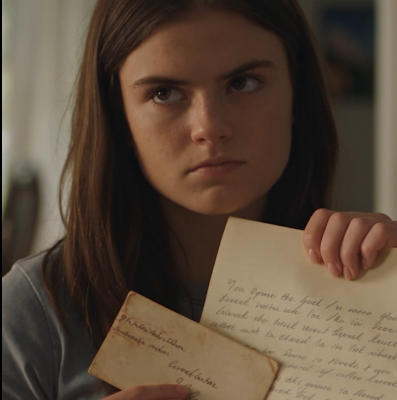
“I wrote letters. Every month. Every year. I never got a response. I didn’t know if you had received them. I didn’t know if you had read them. I didn’t know if you had thrown them away.”
Sarah’s eyes filled with tears. “I never knew you wrote. My mother told me you left. She told me you didn’t want us.”
“I never left. I was forced out. I was told I would never see my daughter again. I was told I would be arrested if I came near her. I didn’t know what else to do. So I wrote. I wrote and I wrote and I wrote. And I waited.”
“I’m sorry.”
“You don’t have to apologize. You didn’t know.”
“I know. But I’m still sorry.”
Thomas was quiet for a moment. Then he asked:
“Do you want to know why I never stopped looking for you?”
Sarah wiped her eyes. “Yes.”
“Because you were my family. And family is not something you give up on. No matter how long it takes. No matter how many years pass. No matter how many letters go unanswered. Family is forever.”
—
**The Meeting**
Sarah drove four hours to meet him.
She walked into the assisted living facility and found him sitting in the common room, by the window. He was old—older than she had imagined. His hair was white, his hands were wrinkled, his back was bent.
But his eyes were bright. And when he saw her, he smiled.
“You look like her,” he said. “Your mother. You look like her.”
Sarah sat down beside him. She did not know what to say. She had practiced this moment in her head a hundred times. But now that she was here, the words would not come.
Thomas reached out and took her hand.
“You don’t have to say anything. Just being here is enough.”
Sarah nodded. She held his hand. She looked out the window at the gray sky and the rain that had begun to fall.
And for the first time in her life, she felt like she was home.
—
**The Lesson**
Never let someone else decide who you are allowed to love. Never let fear keep you from the truth. Never let a lie become the story you tell yourself.
Sarah almost believed her mother. She almost accepted the story. She almost moved on.
But a nurse dropped a file. A name appeared on a page. A question demanded an answer.
And the truth came out.
Because sometimes the bravest thing you can do is pick up the phone—even when everyone tells you not to.