
**Title: **
—
**Part 1: The Snow**
The snow began falling on the evening of March 30, 1922.
It was a late-season storm—heavy, wet, relentless—the kind that blanketed the fields and forests of Bavaria in a silence so deep it felt like the world had stopped. The farm known as Hinterkaifeck sat isolated in the countryside, a cluster of buildings surrounded by woods and fields, miles from the nearest village. It was a place where the wind howled through the eaves and the trees pressed close and the only sounds were the lowing of cattle and the creak of old timbers.
Andreas Gruber, the farmer, had been uneasy for days. He had told his family about the footprints—a line of tracks leading from the edge of the forest toward the farmhouse, pressed cleanly into the snow. He had followed them. He had seen where they ended. But there were no footprints leading back.
Someone had walked to the farm. Someone had not walked away.
He had also heard noises in the attic—soft thumps, shuffles, the sound of movement overhead. He had gone up to check. He had found nothing. No one. Just dust and old boxes and the dark spaces between the rafters.
He had told his wife, Cäzilia. He had told his daughter, Viktoria. He had told the new maid, Maria. They had all been frightened. But they had not left. Where would they go? The farm was their home. The farm was their life.
On the night of March 31, 1922, something terrible happened at Hinterkaifeck.
—
**Part 2: The Discovery**
The farm was not discovered for four days.
The first sign that something was wrong came on April 1, when a neighbor noticed that the postman had left mail in the mailbox—unusual, because someone usually collected it. The next day, another neighbor saw smoke rising from the chimney. The day after that, a third neighbor heard the cattle lowing, restless and hungry.
On April 4, a group of neighbors finally decided to investigate.
They walked up the long dirt road to the farm. The snow had melted into slush. The yard was muddy and churned. The farmhouse was silent.
They knocked on the door. No answer. They pushed it open.
The smell hit them first—the sweet, sickening stench of death. Then they saw the bodies.
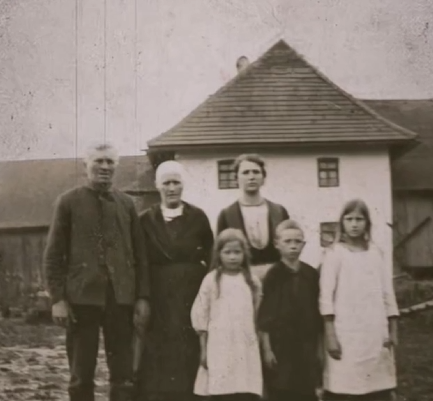
Andreas Gruber was found in the barn, his skull crushed, his body covered with hay. His wife, Cäzilia, was found in the farmhouse, her head battered, her body lying near the hearth. Their daughter, Viktoria, was found in her bedroom, her skull fractured, her body partially undressed. Her two children—Cäzilia, age seven, and Josef, age two—were found in their beds, their small bodies bludgeoned, their blankets pulled up to their chins. The maid, Maria, was found in her room, her head crushed, her body twisted on the floor.
Six people. Three generations. All dead.
—
**Part 3: The Evidence**
The investigators arrived later that day.
They searched the farm from top to bottom. They examined the bodies. They collected evidence. They interviewed neighbors. They tried to reconstruct what had happened.
The murders had been brutal. The weapon—a mattock, a heavy tool used for digging—had been used with tremendous force. The killer had struck again and again, crushing skulls, breaking bones, destroying faces. It had been a frenzy of violence, a storm of rage.
But there was something else. Something that made the investigators pause.
Someone had stayed on the farm after the murders.
The cattle had been fed. The animals had been given hay and water. Smoke had come from the chimney—a fire had been lit. Food had been eaten—bread and meat and cheese had been taken from the pantry. The killer had not simply murdered the family and fled. He had stayed. He had lived in the house with the dead.
For days.
The investigators searched the house again. They checked every room, every closet, every crawlspace. They found nothing. No sign of the killer. No indication of where he had gone.
The farmhouse was demolished in 1923. During the demolition, investigators discovered the murder weapon—the mattock—hidden inside the building, tucked between the rafters in the attic.
But the killer was never identified.
—
**Part 4: The Suspects**
The investigation focused on several suspects.
The first was a man named Karl, a former farmhand who had worked at Hinterkaifeck years earlier. He had been dismissed after a dispute with Andreas Gruber. He had threatened revenge. He had disappeared after the murders. The police searched for him. They found him—but they could not prove he had committed the crime.
The second was a man named Josef, a neighbor who had been seen near the farm on the night of the murders. He had a history of violence. He had a motive—a land dispute with Andreas Gruber. But again, there was no proof.
The third was a man named Andreas, a relative of the Gruber family. He had been involved in a dispute over inheritance. He had been seen in the area on the night of the murders. But the evidence against him was circumstantial.
The investigation dragged on for years. Dozens of suspects were interviewed. Hundreds of tips were followed up. Thousands of pages of documents were filled.
But no one was ever charged.
—
**Part 5: The Theories**
The case became a legend.
Over the decades, dozens of theories emerged. Some said the killer was a stranger—a drifter, a wanderer, a madman who had stumbled upon the farm and decided to kill. Some said the killer was a local—a neighbor, a rival, a man with a grudge. Some said the killer was a member of the family—a secret lover, an illegitimate child, a hidden heir.
Some said the killer was a woman. Some said the killer was a soldier, traumatized by war. Some said the killer was a supernatural entity—a demon, a spirit, a creature from the woods.
No one knew for sure.
The case was never solved.
—
**Part 6: The Aftermath**
The farm at Hinterkaifeck was destroyed.
The buildings were demolished. The land was divided. The trees grew over the foundations. The dead were buried in the village cemetery—six graves, six headstones, six names.
But the memory remained.
The people of the village did not speak of it. They did not tell their children. They did not write it down. They simply lived with the knowledge that something terrible had happened there—something that could not be explained, something that could not be undone.
And sometimes, on dark nights, when the snow fell and the wind howled through the trees, they wondered if the killer was still out there—somewhere—watching, waiting, ready to return.
—
**Part 7: The Lesson**
The tended animals and the smoke from the chimney made the days after the killings particularly difficult to imagine. Work had continued while the people who normally performed it lay dead. The farm had looked inhabited because it was inhabited—but by someone whose name the investigation never established.
Demolishing the building uncovered a weapon. It did not remove the stranger from the story, or explain how closely he had listened before he acted.
The footprints in the snow led to the farm. They did not lead away. The killer had come from the forest. He had hidden in the attic. He had waited. He had struck.
And then he had stayed—feeding the cattle, lighting the fire, eating the food—while the bodies of the family lay where he had left them.
He had lived among the dead. He had made himself at home.
And then he had disappeared—into the forest, into the snow, into the shadows—leaving behind only questions.
—
**The End**