
**Title: **
In the autumn of 1947, the fields of Kentucky had begun to fade from green to gold, and the air carried the sharp, clean bite of approaching winter. At Faraway Farm, near Lexington, the most famous horse in America was growing old.
His name was Man o’ War.
He was thirty years old—ancient for a Thoroughbred—and age had softened the fire in his eyes and slowed the proud arch of his neck. His coat, once the color of polished chestnut, had grown rough and dull. His legs, which had once carried him across finish lines with impossible speed, were stiff and thin. But even in decline, there was something regal about him. The grooms still spoke to him in quiet voices. Visitors still came to the fence and stared. Children still asked their parents if this was really *him*—the horse they had heard about in stories, the horse whose name had become a synonym for greatness.
On November 1, 1947, Man o’ War died.
The official cause was a suspected heart attack. He had been failing for days, and the end came quietly, in his stall, surrounded by the smells and sounds that had been his world for decades. He was thirty years old. He had outlived most of his rivals, most of his offspring, and most of the people who had watched him run in his prime. But he had not outlived his legend.
Word spread quickly. The farm’s telephone rang constantly. Reporters called. Radio stations called. Ordinary people called, asking if it was true, asking if they could come, asking if they could bring flowers. The men who had cared for Man o’ War for years stood outside the barn with red eyes and clenched jaws. They had known this day would come. They had not known how much it would hurt.

**The Coffin**
A solid oak coffin was built.
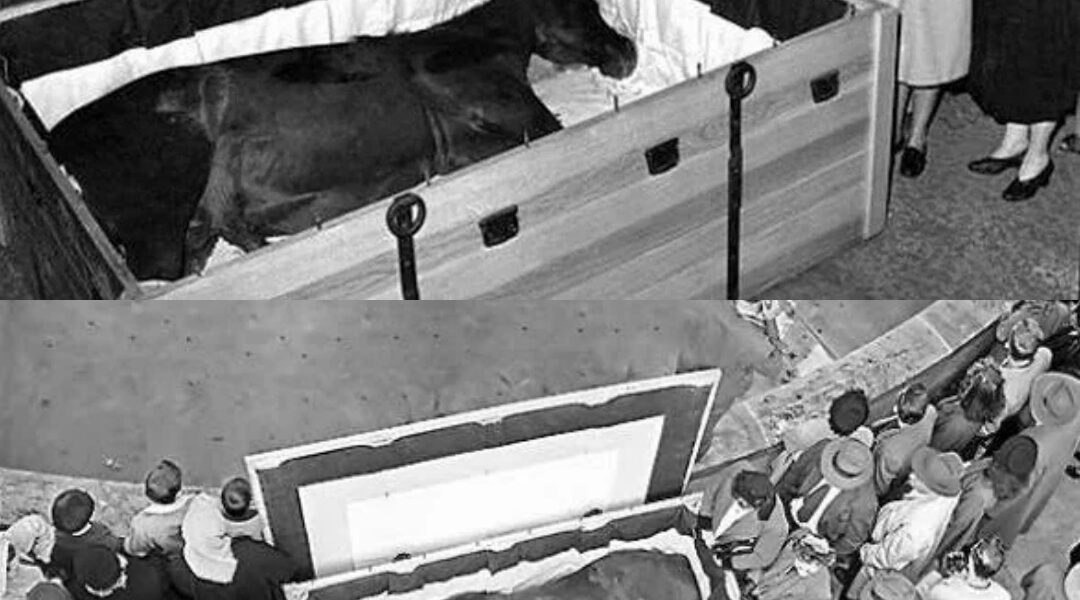
It was not a small thing. Man o’ War had been a large horse—broad-chested, powerful, with a presence that filled a room. The coffin was long and heavy, lined with cloth, built to hold the body of a champion. It was placed near his stall at Faraway Farm, in the barn where he had lived and been visited by thousands of admirers. The barn had always been a place of life—the rustle of hay, the stamp of hooves, the low nickering of horses. Now it was a place of silence.
Man o’ War was embalmed.
It was a decision made by those who loved him and those who understood what he meant to the public. He became the first horse to be embalmed—a final honor for an animal who had become more than an animal. His body was prepared with care. His racing colors—the colors he had carried to victory—were draped over the coffin. The cloth was bright against the dark wood, a reminder of the speed and glory that had once defined him.
Then the doors were opened.
—
**The Mourners**

More than 2,500 people came to pay their respects.
They came from Lexington and from the surrounding counties. They came from other states. They came in cars and trucks and farm wagons. They stood in a long, quiet line that wound past the barn and into the fields. They did not push. They did not shout. They did not treat it as a spectacle. They treated it as a funeral.
Farmers came in their work clothes, their hats held in their hands. Mothers came with children who had never seen Man o’ War race but who had grown up hearing his name. Old men came who remembered the 1920s—who remembered the roar of the crowd, the blur of chestnut legs, the impossible ease with which he won. They stood beside the coffin and remembered.
Some of them cried. Some of them simply stared. Some of them whispered thank you.
The line moved slowly. Each person was given a moment. Each person was allowed to say goodbye. The barn was filled with the soft shuffle of feet and the muffled sound of grief. Outside, the November wind moved through the trees, and the fields stretched away toward the horizon, empty and still.
—
**The Broadcast**
NBC radio broadcast the ceremony live across the nation.
It was an extraordinary decision. Radio was for news, for music, for speeches by presidents and generals. It was not usually for horses. But Man o’ War was not usually a horse. He was an American legend. He had captured the imagination of a country during a time when the country needed heroes. He had run in the 1920s—the decade of jazz and speakeasies and breakneck optimism—and he had run faster than anyone had ever seen.
People gathered around their radios in living rooms and kitchens and general stores. They listened to the voices of the announcers. They listened to the descriptions of the coffin, the colors, the mourners. They listened to the silence. And in that silence, they remembered.
Some of them had seen him race. Some of them had only read about him. Some of them had bet on him and won. Some of them had bet against him and lost. But all of them knew who he was. All of them understood what he represented.
He was greatness. He was speed. He was the proof that some things in this world are truly extraordinary.
—
**The Legend**
Man o’ War was born in 1917.
He was a chestnut colt with a white star on his forehead and a temperament that could charitably be described as difficult. He was not gentle. He was not patient. He was not easy to train. But he was fast. He was faster than any horse anyone had ever seen. He won twenty of his twenty-one races. His only loss came to a horse named Upset—a defeat that became so famous that the word “upset” entered the language as a term for an unexpected victory.
He won by lengths. He won by ridiculous margins. He won so easily that jockeys on other horses sometimes stopped trying. He was so dominant that he was retired at the age of three, because there was no one left to race against.
At stud, he became one of the greatest sires in history. His offspring included War Admiral, the 1937 Triple Crown winner, and Hard Tack, the sire of Seabiscuit. His bloodline shaped the American Thoroughbred for generations. His name became a standard against which all other horses were measured.
But his legacy was not just about speed. It was about spirit. It was about the way he ran—head high, ears pricked, as if he knew he was the best and enjoyed proving it. It was about the way people felt when they watched him. It was about the way he made them believe in something larger than themselves.
—
**The Farewell**
The funeral ended.
The coffin was carried to a quiet spot on Faraway Farm. The grave was dug. The earth was piled beside it. The racing colors were folded and placed with him. The oak coffin was lowered into the ground.
The people who had gathered began to drift away. They walked back to their cars and their trucks and their farm wagons. They drove home through the fading autumn light. They did not speak much. There was nothing to say.
The barn was quiet. The fields were empty. The wind moved through the trees.
Man o’ War was gone.
But his greatness never faded. His story lived on—in record books and history books, in the memories of those who had seen him, in the bloodlines of the horses who came after him. He became a timeless reminder that true legends are never forgotten.
And on a cold November day in 1947, more than 2,500 people stood in line to say goodbye to a horse who had become an American icon—proof that greatness, once witnessed, is never truly lost.
—
**The End**