

—
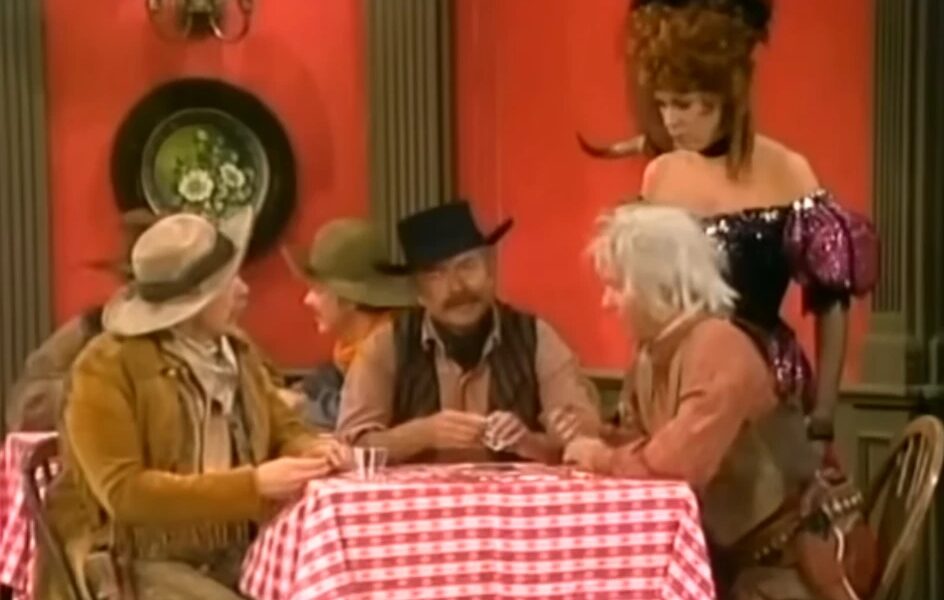
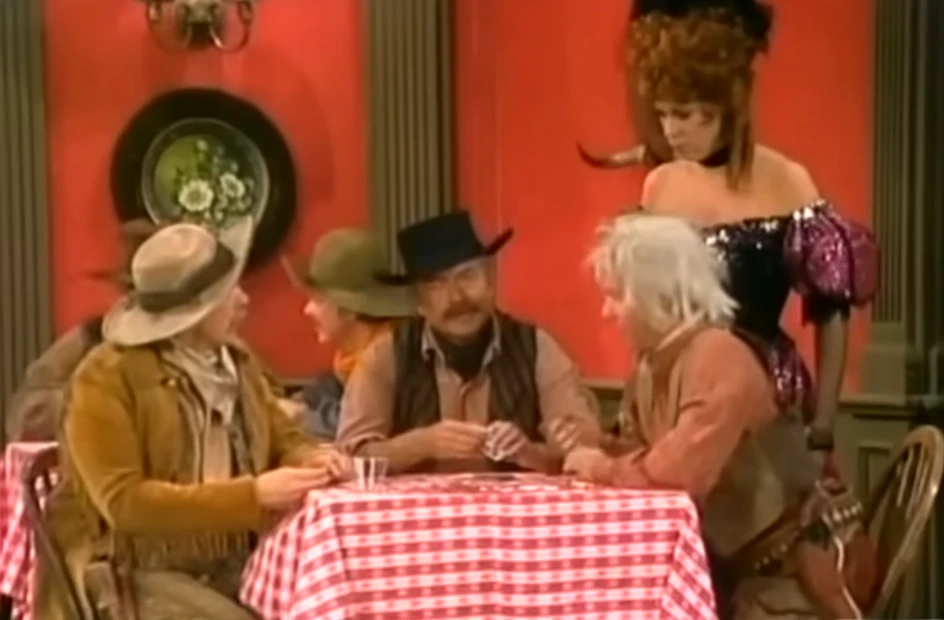
The saloon was dusty and dim, the kind of place where the swinging doors creaked and the piano player had long since given up. A few wooden tables were scattered across the floor. A bar ran along the back wall, lined with bottles that had never seen a real drink. And in the center of it all, Harvey Korman stood with his hands on his hips, wearing a sheriff’s star and a look of profound exasperation.
He was supposed to be the tough lawman—the man who kept order in a town full of outlaws, drifters, and troublemakers. But on this particular afternoon, his biggest problem was not a gunslinger or a cattle rustler. It was Tim Conway.
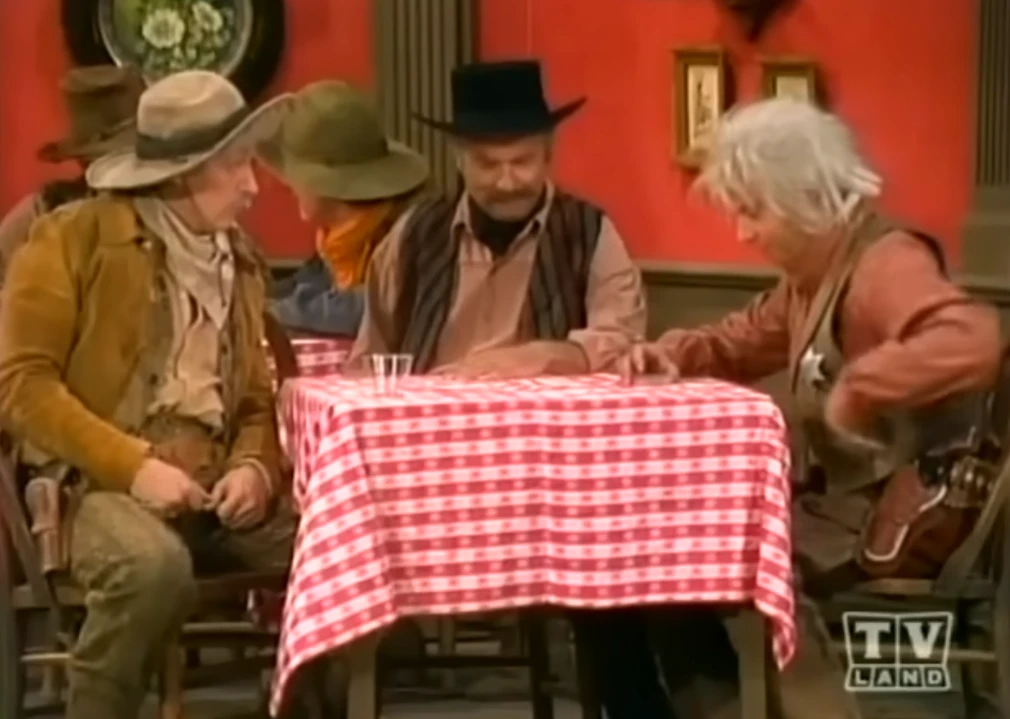
Conway shuffled through the saloon doors as the Oldest Man—a character so ancient, so slow, so utterly devoid of urgency that he made a tortoise look like a sprinter. He was dressed in a sheriff’s vest that hung loosely on his thin frame, a hat that was too big for his head, and a pair of boots that seemed to weigh him down with every step. He carried a cane in one hand and a badge in the other, and he looked around the saloon as if he had never seen one before.
Harvey watched him. His jaw tightened. His eyes narrowed. He had been waiting for his deputy for twenty minutes, and now that the man had finally arrived, he was moving at a pace that suggested he might not reach the bar before sundown.
“Finally,” Harvey said. “I’ve got an outlaw in the jailhouse, and I need you to guard him.”
Conway nodded. He did not move.
“Did you hear me?” Harvey asked. “I need you to guard the prisoner.”
Conway nodded again. He looked at the jailhouse door. He looked at Harvey. He looked at the audience. He adjusted his hat. He shifted his weight. He took a step.
The audience laughed. They knew what was coming.
Harvey closed his eyes. He took a deep breath. He opened his eyes. Conway was still there, still moving, still taking his time.
“Are you going to get there today?” Harvey asked.
“I’m going as fast as I can,” Conway said.
“You’re not moving.”
“I’m moving slowly.”
“There’s a difference?”
“There’s a big difference.”
Conway took another step. Then another. Then he stopped to adjust his boot. Harvey watched him with the expression of a man who had just realized that his entire day was going to be spent watching Tim Conway adjust his boot.
The audience roared. Harvey’s shoulders began to shake. He was not supposed to laugh. He was supposed to be a tough Western sheriff. But Tim Conway was making it impossible.
**The Jailhouse**
The jailhouse was a small room with a single cell and a wooden desk. The prisoner—a man in a black hat and a sneer—was sitting on a cot, his arms crossed, his eyes fixed on the door. He had been waiting for his escape attempt for over an hour. He had been waiting for his guard to arrive for just as long.
When Conway finally shuffled through the door, the prisoner stood up.
“It’s about time,” he said. “I thought you’d never get here.”
Conway looked at him. He looked at the cell. He looked at the keys on the desk. He looked back at the prisoner.
“I’m here now,” he said.
“Are you going to guard me?”
“That’s the plan.”
“Then guard me.”
Conway nodded. He walked to the desk. He sat down. He picked up a newspaper. He began to read.
The prisoner stared at him. “What are you doing?”
“Reading.”
“You’re supposed to be guarding me.”
“I am guarding you.”
“You’re reading a newspaper.”
“I can do both.”
“You can’t do both.”
“I’m doing it right now.”
The prisoner looked at the audience. The audience laughed. The prisoner looked at Harvey, who was standing in the doorway, his face a mask of disbelief.
“Is this the best you’ve got?” the prisoner asked.
Harvey sighed. “Apparently.”
**The Escape**
The prisoner decided to escape.
He waited until Conway was deeply engrossed in his newspaper. Then he reached through the bars, grabbed the keys from the desk, and unlocked the cell door. He stepped out. He looked at Conway. Conway did not look up.
The prisoner walked to the door. He opened it. He looked back at Conway. Conway turned a page.
The prisoner walked out.
Harvey appeared in the doorway. He saw the empty cell. He saw the open door. He saw Conway reading the newspaper.
“Where’s the prisoner?” Harvey demanded.
Conway looked up. He looked at the cell. He looked at the door. He looked at Harvey.
“He was here a minute ago,” he said.
“He escaped!”
“Did he?”
“Yes! He walked right past you!”
Conway folded the newspaper. He set it on the desk. He stood up. He adjusted his hat. He looked at the door.
“I’ll go after him,” he said.
“You’ll go after him?”
“Yes.”
“You can’t catch him. You can barely walk.”
“I’ll walk slowly. He’ll get tired.”
The audience howled. Harvey’s face went red. He was supposed to be angry. He was supposed to be a tough sheriff. But Tim Conway was making it impossible to keep a straight face.
—
**The Chase**
Conway walked out of the jailhouse. He walked down the street. He walked past the saloon. He walked past the general store. He walked past the bank. He walked slowly. Very slowly.
The prisoner was nowhere to be seen. He had already disappeared into the hills. But Conway kept walking. He walked past the edge of town. He walked into the desert. He walked until he reached a large rock. He sat down on the rock. He looked at the horizon.
Harvey caught up with him. He was out of breath. His face was red. His hat was askew.
“What are you doing?” he demanded.
“Resting,” Conway said.
“Resting? The prisoner is getting away!”
“He’s already gotten away.”
“Then why are we out here?”
“We’re giving him a head start.”
“A head start? He’s gone!”
“Then we’ll catch him tomorrow.”
“Tomorrow?”
“Or the next day.”
Harvey stared at him. He stared at the desert. He stared at the audience. He opened his mouth. No words came out.
Conway stood up. He adjusted his hat. He began to walk back to town. Slowly. Very slowly.
Harvey followed him. He did not say a word. He simply walked behind him, his shoulders shaking, his face contorted, his composure crumbling with every step.
—
**The End**
The sketch ended with Conway back in the jailhouse, reading his newspaper, and Harvey standing in the doorway, his face a mask of exhausted disbelief. The prisoner was never caught. The town was never saved. But the audience had laughed until their sides hurt.
Tim Conway had done it again.
He had taken a classic Western trope—the tough sheriff, the daring escape, the chase across the desert—and turned it into a masterclass of slow-motion comedy. He had made the audience wait. He had made them anticipate. He had made them laugh at things that should not have been funny.
And he had made Harvey Korman struggle to keep a straight face.
That was the real joke. Not the slow sheriff. Not the escaped prisoner. Not the desert chase. The real joke was Harvey Korman, standing in the doorway, trying desperately not to laugh.
He failed.
—
**The Lesson**
Tim Conway understood something that few comedians ever master. He understood that anticipation can be funnier than the punchline. He understood that a pause can be a joke. He understood that the slowest man in the room can be the funniest man in the room.
Harvey Korman understood something too. He understood that the hardest job in comedy is not making the audience laugh. It is keeping a straight face while someone else makes them laugh.
Together, they created something unforgettable.
One sheriff. One prisoner. One desert chase. One painfully slow step at a time.
And Harvey Korman trying desperately to survive the ride without laughing.
—
**The End**