
**Title: **
—
**Part 1: The Legend**
Clinton Road was not the kind of place you went on purpose.
It was a narrow, winding stretch of asphalt that cut through the dense forests of West Milford, New Jersey—a road that seemed to swallow the light and spit out shadows. It was famous, in the way that local legends are famous, for being haunted. There were stories of ghostly cars that chased you down the winding curves, of a phantom truck that appeared out of nowhere, of a creepy clown statue that moved when you weren’t looking, of a boy who had drowned in the stream beneath the old bridge and whose spirit still lingered, waiting for someone to throw a coin and make a wish.
The legend of the bridge was simple. You stood at the edge of the stream, you threw a quarter into the water, and you waited. If the boy was listening, he would send the coin back—a sign that he had heard you, that he was still there.
Most people laughed it off. It was a story, a campfire tale, a way to scare your friends on a boring Friday night.
But in 1996, two teenagers decided to find out if it was true.
—
**Part 2: The Test**
Their names were Danny and Chris.
They were seventeen years old, juniors at the local high school, best friends since the third grade. They had heard the stories about Clinton Road a hundred times—from older kids, from older brothers, from the kind of websites that catalogued local haunts and urban legends. They had never gone themselves. They had never had a reason to.
But that night, they were bored. They had finished their homework. They had played video games until their eyes hurt. They had nothing to do and nowhere to go.
“Let’s go to Clinton Road,” Danny said.
Chris laughed. “You’re kidding, right?”
“No. Let’s do it. Let’s see if the bridge is real.”
Chris hesitated. He had heard the stories too. He had heard about the ghost boy, the phantom cars, the feeling of being watched. He did not believe in ghosts. But he also did not like the idea of driving down a dark road at midnight, looking for something that might be looking back.
“Come on,” Danny said. “It’ll be fun. We’ll throw a quarter, wait a few minutes, and then leave. Nothing’s going to happen.”
Chris sighed. “Fine. But if we get murdered, I’m blaming you.”
—
**Part 3: The Bridge**
They drove to Clinton Road just after midnight.
The road was as dark as they had imagined. The trees pressed close on either side, their branches forming a canopy that blocked out the moon. The asphalt was cracked and uneven. The only light came from the car’s headlights, cutting a narrow tunnel through the darkness.
They parked beside the old bridge—a narrow, iron-truss structure that spanned a shallow stream. The water was black and still. The bridge creaked in the wind.
Danny got out of the car. He walked to the edge of the stream. He pulled a quarter from his pocket.
“Here goes nothing,” he said.
He threw the quarter into the water. It landed with a soft splash and sank out of sight.
They waited. The stream gurgled. The wind rustled through the trees. Nothing happened.
Danny laughed. “See? I told you. Just a story.”
They got back into the car. Chris started the engine. They were about to drive away when something struck the windshield.
It was a sharp, metallic ping—the sound of metal hitting glass. They both jumped.
“What was that?” Chris said.
Danny looked at the windshield. There, stuck in the wiper blade, was a quarter.
The same quarter.
It was wet. It was cold. It was exactly the kind of quarter Danny had thrown into the stream.
Neither of them had touched it.
—
**Part 4: The Boy**
They stared at the quarter for a long moment. Then Chris looked in the rearview mirror.
“Danny,” he whispered. “There’s someone behind us.”
Danny turned. In the middle of the road, standing perfectly still, was a little boy.
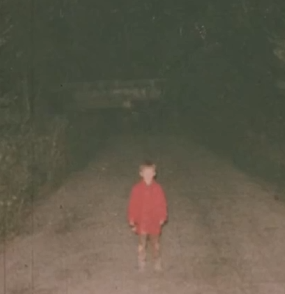
He was small—maybe six or seven years old—with pale skin and dark hair. He was wearing a red jacket. He was not moving. He was not speaking. He was simply standing there, watching them.
“Drive,” Danny said. “Drive now.”
Chris slammed his foot on the accelerator. The car surged forward. They sped down Clinton Road, the trees blurring past, the headlights cutting through the darkness.
A few minutes later, they saw him again.
He was standing beside the road, just at the edge of the headlights. The same red jacket. The same pale face. The same stillness.
Chris screamed. He swerved. He kept driving.
A third time, they saw him—closer now, standing in the middle of the road, his arms at his sides, his eyes fixed on the car.
Chris did not stop. He did not slow down. He drove until they reached the gas station at the edge of town. He pulled into the lot, killed the engine, and sat there, his hands shaking, his breath coming in short, sharp gasps.
Danny was crying. “What was that? What was that?”
Chris did not answer. He could not answer.
—
**Part 5: The Police**
They called the police from the payphone outside the gas station.
An officer arrived within fifteen minutes. He was a middle-aged man with a tired face and a calm voice. He listened to their story without interrupting. He wrote down their names. He wrote down the location. He wrote down the description of the boy.
Then he went silent.
“What?” Danny asked. “What is it?”
The officer looked at them. His face was pale.
“A local boy disappeared near that bridge years ago,” he said. “He was six years old. He was wearing a red jacket. They never found him.”
Chris felt the blood drain from his face.
The officer asked them one more question.
“What was he wearing?”
“We couldn’t see his face,” Chris said. “Only his red jacket.”
The officer looked at them strangely. Then he asked them to open the trunk.
—
**Part 6: The Trunk**
Chris got out of the car. He walked to the trunk. He unlocked it. He lifted the lid.
Inside was a red child’s jacket.
It was soaking wet. It was crumpled. It was lying on top of the spare tire, as if someone had placed it there.
Neither of them had put it there.
Chris stared at the jacket. His hands were shaking. His heart was pounding. He felt as if the ground had opened up beneath him.
The officer reached into the trunk. He picked up the jacket. He held it up to the light.
“Is this yours?” he asked.
“No,” Chris whispered. “No, it’s not.”
The officer looked at the jacket. He looked at the teenagers. He looked at the dark road behind them.
“I think you should go home,” he said. “Now.”
They did not argue. They got in the car. They drove away. They did not stop until they reached Chris’s house.
—
**Part 7: The Aftermath**
The police investigated the jacket.
They tested it for DNA. They compared it to the clothing worn by the missing boy. They checked the trunk of Chris’s car for fingerprints.
They found nothing.
The jacket was the same brand, the same size, the same color as the one the missing boy had been wearing. But there was no evidence linking it to the boy. There was no evidence linking it to anyone.
The case was never solved.
Chris and Danny never went back to Clinton Road. They never spoke about that night again—not to their friends, not to their families, not to each other. They graduated from high school. They went to college. They got jobs. They got married. They had children.
But sometimes, late at night, when the wind blew through the trees and the darkness pressed against the windows, they would remember.
They would remember the quarter. They would remember the boy. They would remember the jacket.
And they would wonder if they had really seen a ghost.
Or if something else had been following them all along.
—
**Part 8: The Lesson**
The officer’s question turned a frightening description into a practical instruction. Opening a trunk was something the teenagers understood how to do. What lay inside made their escape route feel useless.
The jacket was wet where the car should have kept it dry, and recognizable where neither of them remembered putting it. The stream had not remained behind them. Somehow, a piece of it had traveled with them all the way to the police.
The legend of Clinton Road was not just a story. It was not just a campfire tale. It was something real—something that had reached out and touched them.
And it had left something behind.
—
**The End**