The Butcher’s Basement: The Cheapest Meat in Town Came With a Secret That No One Wanted to Know.8hr

**Title: **
—
**Part 1: The Shop on Maple Street**
The shop was called Grieves’ Quality Meats, though the sign above the door was so faded that the word “Quality” had worn away to a ghost. It sat on the corner of Maple and Third in the small town of Ashland, Pennsylvania—a brick building with a green awning and a window display that hadn’t changed since the Reagan administration. Inside, the walls were lined with white tiles, the floor was covered in sawdust, and the air smelled of cold steel and fresh blood.
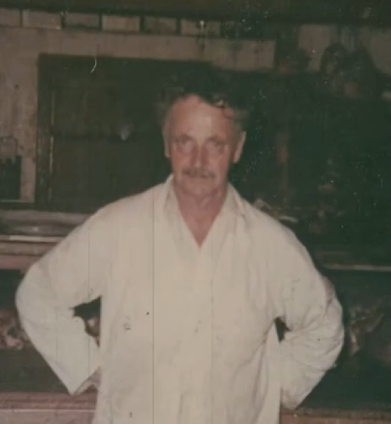
The butcher, Arthur Grieves, was a quiet man in his sixties with thick hands and a permanent smudge of crimson under his fingernails. He had opened the shop in 1978, and in the decades since, he had become a fixture of the town—a man who knew everyone’s names, who remembered how they liked their steaks cut, who always threw in a free pound of ground beef for the elderly customers. His prices were the lowest in three counties. Families on tight budgets swore by him. He was, by all accounts, a pillar of the community.
Thomas Crane started working at Grieves’ in the spring of 1994. He was twenty-two years old, a college dropout who had come home to take care of his ailing mother. He needed a job—any job—and Grieves had hired him on the spot. “You look like a hard worker,” the butcher had said, shaking his hand with a grip that was almost too strong. “I’ll teach you everything you need to know.”
For the first few months, everything seemed normal. Thomas learned to cut meat, to wrap it in brown paper, to weigh it on the old brass scale. He learned the rhythms of the shop—the morning rush of housewives and retirees, the quiet afternoons when Grieves would retreat to his office and leave Thomas to mind the counter. He learned to ignore the strange things.
The strange things were small at first. The fact that Grieves never received deliveries during the day. The fact that a plain white van would pull up behind the shop every few nights—always after midnight—and Grieves would unload heavy boxes and carry them down to the basement. The fact that Grieves would never let anyone else go into the basement. The fact that the meat in the display case was always fresh, always plentiful, always cheap—even when the suppliers in the region were struggling.
Thomas asked about the deliveries once. “Where does the meat come from?” he said.
Grieves smiled. It was a thin smile, a cold smile, a smile that didn’t reach his eyes. “Don’t worry about it,” he said. “Just focus on the counter.”
—
**Part 2: The Night**
Thomas couldn’t stop thinking about it.
He tried to tell himself it was nothing. He tried to tell himself that Grieves was just a private man, that the basement was probably just a storage room, that the midnight deliveries were probably just a way to avoid the heat of the day. But the questions kept gnawing at him. The unanswered questions. The strange smile.
One night in October, Thomas decided to find out.
He stayed after closing. He told Grieves he needed to finish inventory. Grieves nodded and disappeared into his office. Thomas waited. The clock on the wall ticked. The fluorescent lights hummed. The shop grew dark and quiet.
At 12:15 AM, Thomas heard the sound of a vehicle pulling up behind the shop.
He crept to the back window. A white van was parked in the alley. Its headlights were off. Its engine was still running. Grieves emerged from the back door and walked to the van. He spoke to the driver—a voice Thomas couldn’t hear—and then began unloading boxes. Heavy boxes. Cardboard boxes, stained at the corners.
Grieves carried them inside one by one. He carried them past Thomas’s hiding spot. He carried them down the stairs to the basement.
Thomas waited until Grieves had gone back outside for another load. Then he slipped down the stairs.
—
**Part 3: The Basement**
The basement was cold.
It was colder than it should have been. The air smelled of metal and something else—something sweet and rotten, something that made Thomas’s stomach turn. The only light came from a single bare bulb hanging from the ceiling.
Thomas moved slowly. He passed shelves lined with old tools—saws, cleavers, hooks. He passed a workbench covered in butcher paper. And then he saw the refrigerator.
It was an old commercial unit, the kind you’d find in a restaurant or a hospital. It was white and dented and humming softly. Thomas opened it.
Inside were packages. Dozens of them. Wrapped in brown paper and tied with string. They were stacked neatly on the shelves, each one labeled with a date written in black marker.
Some of the dates were recent—days old. Others were months old. Some went back years.
Thomas’s hands were shaking. He picked up one of the packages. It was heavy. It was cold. He did not open it.
He looked at the shelf beside the refrigerator. There were more items there. A wallet. A wedding ring. A small stack of photographs.
He picked up the photographs. The first one showed a young woman smiling at the camera. The second showed a man in a hunting cap. The third showed a child—a little girl with pigtails and a missing tooth.
Thomas felt the floor tilt beneath him. He felt the walls close in. He felt the cold air wrap around his throat like a pair of hands.
He ran up the stairs. He burst through the back door. He ran to the payphone on the corner—this was 1994, and cell phones were still a luxury—and he called the police.
—
**Part 4: The Search**
The police arrived within twenty minutes.
They searched the basement. They photographed the refrigerator. They catalogued the packages. They collected the wallets, the wedding ring, the photographs. They searched the rest of the shop. They searched Grieves’s office. They searched the alley behind the building.
But Grieves was gone.
The van was gone.
The butcher had disappeared into the night, leaving behind his shop, his tools, his refrigerator full of unlabeled packages.
The investigation lasted for months. The state police were called in. The FBI was notified. The packages were sent to a lab in Philadelphia for analysis.
The results were never made public.
What the investigators found—what they suspected—was never officially revealed. The shop was permanently closed. The building was sold. The refrigerator and its contents were removed and destroyed. The wallets and the ring and the photographs were returned to the families of the missing—families who had spent years wondering what had happened to their loved ones.
Thomas Crane was interviewed a dozen times. He told his story again and again. He described the basement. He described the packages. He described the dates. He described the photographs.
But he could not describe what he had seen in Grieves’s eyes when the butcher smiled.
—
**Part 5: The Aftermath**
The town of Ashland never recovered.
The customers who had bought meat from Grieves’ for years—the families who had relied on his low prices, who had trusted him, who had invited him to their barbecues and their church picnics—they were left with questions they could not answer. They had eaten his meat. They had fed it to their children. They had praised his generosity.
Now they wondered what they had really been eating.
The shop on Maple Street remained empty for years. The green awning faded. The windows gathered dust. The sign above the door—*Grieves’ Quality Meats*—was eventually removed, but the building itself seemed to carry a weight that could not be lifted.
Thomas Crane left Ashland. He moved to another town, got another job, tried to build another life. But he never forgot. He never forgot the cold of the basement. He never forgot the smell. He never forgot the dates on the packages.
And sometimes, late at night, when the wind blew through the trees and the darkness pressed against the windows, he wondered if Grieves was still out there—somewhere—still smiling that cold smile, still selling the cheapest meat in town.
—
**Part 6: The Lesson**
The items beside the freezer changed the meaning of the room without requiring anybody to open another package. They belonged to lives outside the shop, to people who had once carried them casually and expected to keep doing so.
The butcher’s departure left investigators with an empty place where a direct answer should have been. For his customers, the closed door was only the beginning of the questions they would take home.
And for Thomas Crane—the young man who had stayed after closing, who had crept down the stairs, who had opened the refrigerator—the questions would never stop.
He had seen the truth. He had seen what was behind the counter.
And he would spend the rest of his life wishing he hadn’t.
—
**The End**