
#
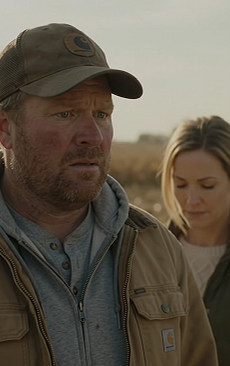
The cornfield had never looked so much like a battlefield. The stalks stood dry and rattling in the late-autumn wind, and between them, two siblings faced each other across a line of wooden stakes that had been driven into the earth only days after their father’s funeral. Dale had done the driving himself. Amy had stood by their father’s old truck and watched, saying nothing. Now Dale was pulling the stakes out of the ground and throwing them, one after another, across the field as if each one were proof of some theft he could not forgive.
“Father’s land gets split in half,” he shouted, his voice carrying over the empty rows. “She doesn’t get one inch more. Not one inch.”
Amy did not argue. She stood beside the rusted truck with her hands shoved into the pockets of her coat and her eyes fixed on the ground. The wind pulled loose strands of hair across her face, but she did not brush them away. She had learned, over the past month, that silence was sometimes the only thing she could afford. Words had a way of becoming weapons in Dale’s hands, and she had no desire to arm him further.
Their father had been dead for less than a month. The house still smelled of him—of pipe smoke and old leather and the faint medicinal smell that had clung to the last years of his life. The neighbors had brought casseroles and condolences, and then they had gone back to their own lives, leaving Dale and Amy to sort through what remained. There was the house. There was the equipment. There was the land. And there was the question of who deserved what.
Dale believed he knew the answer. He had worked the fields as a boy, he said. He had learned the business. He had kept the family name alive while Amy had gone off to the city and then, when their mother fell ill, had come back only long enough to watch her die. That was how Dale remembered it. That was how he told the story to anyone who would listen.
Amy remembered it differently. She remembered leaving her job, her apartment, her whole carefully built life in the city to come home and care for their mother for three years. She remembered the long nights, the doctors’ appointments, the slow erosion of a woman who had once been the center of their family. She remembered Dale’s phone calls, always brief, always hurried, always ending with the same excuse: work was busy, the city was far, he would come when he could. He rarely came.
But Amy had never said any of this aloud. Not to Dale. Not to anyone. She had simply done what needed to be done and then stayed quiet, because she believed that some things did not need to be spoken. She believed that family was not a ledger, and that love was not something you tallied up and presented as a bill.
Dale did not share that belief. He had spent the weeks since the funeral going over the property lines in his head, comparing what he remembered of the old surveys with what he saw on the ground. He had convinced himself that Amy had moved the stakes. He had convinced himself that she was trying to take more than her share. And once he had convinced himself, there was no room left for doubt.
So he had come to the field that morning with a hammer and a fresh set of stakes and a heart full of suspicion. He had driven the new markers into the earth with more force than the job required. He had measured the distances twice. He had glared at Amy across the rows as if she were a stranger who had wandered onto his property. And when she had tried to speak, he had cut her off.
“Don’t,” he had said. “Don’t tell me you didn’t do it. I know what I saw.”
Amy had closed her mouth. She had stood by the truck and waited. She had known, even then, that this moment was coming. She had known it for years. And she had known, too, what she would do when it arrived.
The old man came down the dirt road just as Dale was wrenching another stake from the ground. His name was Earl, and he was seventy-five years old, with hands like worn leather and a back that had been bent by decades of farm work. He had been their parents’ closest friend for as long as either of them could remember. He had taught Dale how to drive a tractor. He had danced at their parents’ anniversary party. He had stood at their mother’s funeral and wept without shame.
Now he walked slowly, carrying a roll of paper in one hand. The paper was yellowed at the edges and soft with age, and he held it the way a man holds something holy. Dale stopped with the stake still in his hand and watched him approach.
“Earl,” he said. “This isn’t a good time.”
“It never is,” Earl said. He walked past Dale without stopping and laid the paper across the hood of the old truck. Then he unrolled it carefully, smoothing the corners with his palms. It was a deed. A property deed, dated 1987.
“This field was never your father’s, Dale,” Earl said. “It was your mother’s.”
Dale stared at the paper. The words were faded but legible. The names were there. The boundaries were there. And the date—1987—was there, older than Dale’s memory of the land, older than the stakes he had just pulled from the ground.
“What are you talking about?” Dale said. His voice had lost some of its force. “Dad worked this land for forty years.”
“He worked it,” Earl said. “But he didn’t own it. It came to your mother from her mother’s side. It was her dowry, her inheritance, her security. Your father knew that. Everyone knew that.”
Earl tapped the deed with one finger. “She left it to Amy,” he said. “All of it. The field. The house. Everything you’re standing on.”
Dale looked at Amy. She had not moved. She had not spoken. She was still standing by the truck with her hands in her pockets, and her face was calm in a way that made Dale’s stomach turn.
“That’s not possible,” Dale said. “She wouldn’t do that. She wouldn’t leave me with nothing.”
“She didn’t leave you with nothing,” Earl said. “She left you with a sister who loves you enough to keep her mouth shut.”
The old man’s voice was quiet but steady. He told Dale then what he had never told anyone. He told him about the year their mother fell ill, about the three years Amy had spent caring for her while Dale stayed in the city. He told him about the nights Amy had slept in a chair beside their mother’s bed, about the meals she had cooked and the medicines she had measured and the hands she had held. He told him about the afternoon their mother had asked Earl to witness the transfer, and about the promise she had asked him to make.
“She told me to keep this deed hidden,” Earl said. “She said if her children ever fought over the land, I should bring it out. Not before. Not unless it was needed.”
Dale’s face had gone pale. He looked at the deed, then at Amy, then back at the deed. The stakes he had pulled from the ground lay scattered around him like the bones of something he had killed without meaning to.
“You knew?” he asked Amy. His voice cracked. “You knew all this time?”
Amy nodded. “She told me before she died.”
“And you never said anything?”
“I didn’t want you to lose the house,” she said. “I didn’t want you to feel like you had nothing. I thought—I thought if I just stayed quiet, we could share it. We could figure it out together.”
She pulled her hands from her pockets and walked toward him. Her boots made soft sounds in the dry earth. When she reached the hood of the truck, she looked down at the deed for a long moment, then looked up at her brother.
“I’ll sign the land with the house over to you,” she said. “All of it. I don’t want to fight you, Dale. I never wanted to fight you.”
Dale opened his mouth, but no words came out.
“I only want one thing,” Amy said. “Put the stakes back. All of them. Exactly where they were before.”
Dale looked at the field. The stakes were everywhere—some half-buried in the dirt, some leaning against the rows, some thrown so far he would have to search for them. He thought about the anger that had driven him to pull them out. He thought about the accusations he had made. He thought about the years he had spent believing he was the one who had sacrificed, the one who had stayed, the one who had done right by their parents.
He thought about the chair beside their mother’s bed, and he wondered who had been sitting in it.
Without a word, he turned and walked into the field. He picked up the first stake and carried it back to the line. He pressed it into the earth and pushed until it stood straight. Then he went for the next one. And the next. And the next.
Amy and Earl watched him in silence. The wind moved through the cornstalks. The old truck ticked as its engine cooled. Dale worked his way across the field, one stake at a time, and with each one he drove into the ground, something in his chest seemed to loosen and then tighten again, like a knot being untied only to be retied in a different shape.
By the time he reached the last stake, the sun was low and the field was golden with late light. He knelt in the dirt and held the stake in both hands. He looked at the line it would mark—the line he had been so certain was a lie—and he thought about his mother’s hands, and his sister’s silence, and the house he had been given without ever earning it.
Then he drove the stake into the ground and bowed his head and wept. It was the first time he had cried since their mother died. It was the first time, in a long time, that he had let himself feel the weight of everything he had refused to see.
Amy did not go to him. She stood by the truck and let him cry. Earl rolled up the deed and tucked it under his arm. The three of them stayed there in the field until the light began to fade, and when Dale finally stood up, his face was wet and his hands were dirty, and he looked at his sister as if he were seeing her for the first time.
“I’m sorry,” he said.
Amy nodded. She did not say it was all right. She did not say it was forgotten. But she walked toward him, and when she reached him, she took his hand, and they stood together among the stakes that marked a field that had never belonged to their father, but had always belonged to their mother—and, in the end, to both of them.