
**Title: **
—
**Part 1: The Photographs**
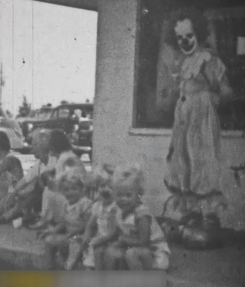
The box was found in the attic of an old house on Maple Street, buried beneath a pile of yellowed newspapers and moth-eaten blankets. It was a simple cardboard box, the kind that once held shoes, and it was filled with photographs. Hundreds of them. Black-and-white, sepia-toned, faded color. They were pictures of children—children at birthday parties, children at school events, children at town picnics. Children laughing, children playing, children standing beside a tall man with a painted smile.
The man was a clown.
He wore a red wig and a white face and a fixed, painted grin. He wore a polka-dot suit and oversized shoes and a red nose. He was the kind of clown that appeared in small-town parades and local carnivals, the kind that made balloon animals and told silly jokes, the kind that parents trusted and children adored.
His name, according to the handwriting on the back of the photographs, was Edward.
The box had been discovered by a new homeowner, a young woman named Claire who had bought the house from an estate sale. She had no idea who Edward was. She had no idea who the children were. She had no idea why the photographs had been hidden in the attic, why they had been wrapped in newspaper, why they had been left behind.
But she knew something was wrong.
She could feel it in the way the photographs felt in her hands—cold, heavy, as if they were carrying a weight that had nothing to do with paper and ink. She could feel it in the way the clown’s eyes seemed to follow her, even though the photographs were decades old. She could feel it in the way the children’s smiles seemed forced, as if they were posing for a camera they did not trust.
She called the police.
—
**Part 2: The Investigation**
Detective Harlan Reeves was assigned to the case.
He was a tall man in his fifties, with grey hair and tired eyes and a reputation for solving cold cases. He had spent thirty years on the force, and he had seen more than his share of darkness. But nothing had prepared him for this.
He spread the photographs across his desk. He examined each one carefully. He noted the dates on the back—*July 1968. October 1970. May 1972.* He noted the locations—*Millbrook Park. The town square. The old schoolhouse.* He noted the children—their faces, their names, their ages.
And then he noticed something strange.
In every photograph, Edward stood at the edge of the crowd. He was never in the center. He was never the focus. He was always at the periphery, his painted eyes turned toward a different child in each picture. A child who was not looking at the camera. A child who was not smiling. A child who seemed to be looking at something else—something beyond the frame.
Harlan checked the dates on the backs of the photographs against the missing persons reports. His blood ran cold.
Every child Edward was looking at had disappeared.
—
**Part 3: The Disappearances**
The disappearances had happened over a period of ten years.
The first was a girl named Sarah, age seven, who vanished from a birthday party in 1968. She was last seen playing near the edge of the woods behind the party house. Her body was never found.
The second was a boy named Michael, age nine, who disappeared from a town picnic in 1970. He was last seen near the clown’s booth. His body was never found.
The third was a girl named Emily, age eight, who vanished from a school carnival in 1971. She was last seen holding a balloon that the clown had given her. Her body was never found.
And on it went. Ten children. Ten disappearances. Ten families left with nothing but questions.
The police had investigated at the time. They had interviewed the clown. They had searched his home. They had found nothing. Edward was a local entertainer—a quiet man who lived alone, who kept to himself, who had no criminal record. He was friendly. He was polite. He was the kind of man who remembered your name and asked about your family.
He was the kind of man you never suspected.
—
**Part 4: The Empty Properties**
Harlan tried to trace Edward’s history.
He searched for records—birth certificates, tax returns, employment records, rental agreements. He found nothing. No birth certificate. No tax returns. No employment records. No rental agreements.
He searched for addresses—the places where Edward had supposedly lived. He found empty lots. Abandoned buildings. Houses that had been torn down decades ago. Every address led to a dead end.
It was as if Edward had never existed.
But the photographs proved he had. The photographs proved he had been there—at the parties, at the picnics, at the carnivals. The photographs proved he had been watching the children. The photographs proved he had been waiting.
Harlan stared at the photographs for hours. He studied the clown’s face—the painted smile, the red wig, the white makeup. He studied the children’s faces—the forced smiles, the averted eyes, the subtle tension in their shoulders.
And then he saw something that made his blood run cold.
In one photograph—the last one in the box—Edward was standing at the edge of a crowd. The crowd was gathered in front of a school. The school was new. The school had not yet been built.
The photograph was dated *September 1976.*
—
**Part 5: The School**
Harlan’s son, Toby, was seven years old.
He had just enrolled at the new elementary school on the other side of town. The school had opened in September 1976—the same month as the photograph. The school where Edward was standing. The school where Edward was holding a balloon.
Harlan examined the photograph more closely. He used a magnifying glass. He studied the background—the trees, the playground, the gate. He studied the foreground—the crowd, the children, the clown.
And then he saw it.
On the back of the balloon, in small, neat handwriting, someone had written a date: *September 5, 1977.*
The first day of the coming school year.
Harlan’s hands began to shake. He looked at the photograph again. He looked at the school. He looked at the clown. He looked at the balloon.
The clown was looking at Toby.
—
**Part 6: The Withdrawal**
Harlan withdrew Toby from the school that morning.
He told his wife it was a safety precaution. He told her he had a bad feeling. He told her he would explain later.
He drove to the school. He walked into the principal’s office. He filled out the paperwork. He took Toby by the hand and led him out of the building.
Toby did not understand. He asked why he could not go to school. He asked why he had to stay home. He asked if he had done something wrong.
Harlan did not answer. He simply held his son’s hand and walked to the car.
That afternoon, he returned to the station. He opened the evidence drawer. He reached for the photograph.
It was gone.
—
**Part 7: The Empty Drawer**
The drawer was locked.
The key was in Harlan’s pocket.
The photograph had been there that morning. He had shown it to his captain. He had shown it to the other detectives. He had placed it in the drawer and locked it himself.
And now it was gone.
He searched the drawer. He searched the desk. He searched the office. He searched the entire station. He found nothing.
The photograph had vanished.
Harlan sat in his office, staring at the empty drawer. He thought about the clown. He thought about the children. He thought about the dates. He thought about the school. He thought about the balloon.
And he thought about Toby.
He had protected his son. He had withdrawn him from the school. He had kept him safe.
But he had not protected everyone else. He had not warned the other parents. He had not told them about the photograph. He had not told them about the clown.
He had lost the evidence. He had lost the only thing he could show another person as a warning.
—
**Part 8: The Lesson**
Edward was never found.
The photographs were never recovered. The children were never found. The case was never solved.
But Harlan never forgot.
He never forgot the clown’s smile. He never forgot the children’s faces. He never forgot the date on the balloon—*September 5, 1977*—the first day of the coming school year.
He never forgot the feeling of the photograph in his hands—cold, heavy, as if it were carrying a weight that had nothing to do with paper and ink.
And he never forgot the lesson.
Edward’s most frightening trick was not hiding his face.
It was making a face so recognizable that nobody noticed how little they knew about its owner.
—
**The End**