
**Title: **
—
**Part 1: The Entrance**
The catacombs beneath the small town of San Vittore had been there for centuries.
They were not the famous catacombs of Rome or Paris, with their guided tours and gift shops and carefully lit corridors. They were older, darker, and largely forgotten—a labyrinth of narrow tunnels and low-ceilinged chambers carved into the soft volcanic stone beneath the town. They had been used as burial sites in the Middle Ages, as hiding places during wars, as storage cellars during times of peace. Now they were mostly sealed off, their entrances marked with rusted iron gates and warning signs in faded red paint.
But the local teenagers knew the ways in. They knew which gates could be forced open, which tunnels were safe to explore, which chambers were worth the risk. The catacombs were a rite of passage—a place to take a girlfriend, to scare a younger sibling, to prove you weren’t afraid of the dark.
On the evening of October 12, 1979, a seventeen-year-old boy named Marco Bellini decided to explore them alone.
He told his parents he would be gone for an hour. He told them he was meeting friends. He told them not to worry. He grabbed a flashlight, a jacket, and a pack of cigarettes. He walked out the door and down the hill toward the old church where the main entrance was hidden.
He never came back.
—
**Part 2: The Search**
His parents reported him missing at 10 PM.
The police arrived within an hour. They interviewed the parents. They interviewed his friends. They searched his room. They found nothing unusual—no note, no sign of trouble, no indication that he had planned to run away.
The next morning, a search team entered the catacombs.
They moved slowly through the tunnels, their flashlights cutting through the darkness. The air was cold and damp and smelled of earth and old stone. The walls were lined with empty burial niches—rectangular hollows where bodies had once been placed, now long since removed or reduced to dust.
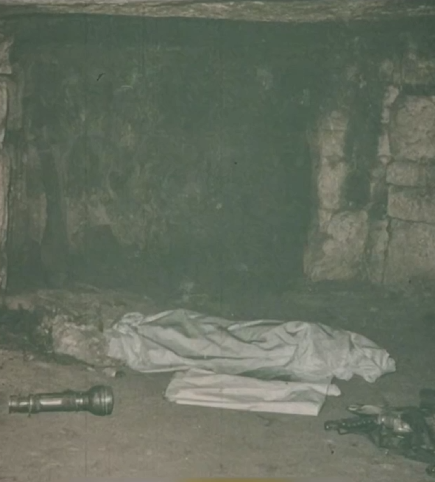
They found Marco’s flashlight near a narrow passage about half a mile from the entrance. It was still on, its beam pointing toward a wall. There was no sign of Marco. No footprints. No disturbed dust. No indication that anyone had been there recently.
They searched deeper.
They checked every tunnel they could reach. They crawled through passages so narrow they had to remove their equipment. They descended into chambers so low they had to crouch. They called Marco’s name again and again, their voices echoing through the stone.
They found nothing.
For three days, the search continued. Volunteers joined. Search dogs were brought in. The local government sent a team of geologists to map the tunnels. But the catacombs were vast—miles of passages, some of them uncharted, some of them too dangerous to enter.
On the fourth day, they found him.
—
**Part 3: The Body**
He was lying on the stone floor of a chamber nearly a mile from the entrance.
The chamber was small—barely ten feet by ten feet—with a low ceiling and walls covered in faded frescoes. The air was cold and still. There was no sign of a struggle. No sign of forced entry. No sign that anyone else had been there.
Marco was lying on his back, his arms at his sides, his eyes closed. He looked peaceful. He looked as if he were sleeping.
But he was not sleeping.
The rescuers approached slowly. They knelt beside him. They checked for a pulse. There was none. They checked for injuries. There were none.
No cuts. No broken bones. No blood. His clothes were almost completely undamaged—his jeans, his jacket, his shoes, all intact. There were no visible wounds on his body. No bruises. No marks of any kind.
He was dead, but there was no obvious cause.
The medical examiner arrived later that day. He examined the body at the scene. He took photographs. He made notes. He ordered the body to be transported to the morgue for a full autopsy.
The autopsy was performed the following morning.
—
**Part 4: The Autopsy**
The medical examiner’s name was Dr. Enrico Mancini. He was fifty-eight years old, with thirty years of experience and a reputation for thoroughness. He had performed thousands of autopsies. He had seen accidents, murders, suicides, natural deaths. He had seen bodies that had been burned, drowned, crushed, stabbed, shot. He had seen everything.
He had never seen anything like this.
Marco’s body was intact on the outside. But when Dr. Mancini opened the chest cavity, he found nothing. No heart. No lungs. The space where they should have been was empty.
He opened the abdominal cavity. No liver. No kidneys. No stomach. No intestines.
The organs were gone. All of them. Every major internal organ had been removed.
But there were no surgical incisions. No evidence that the organs had been removed through any normal procedure. The skin was unbroken. The muscles were undisturbed. The bones were intact. There was no sign of trauma, no sign of violence, no sign of anything that could explain what had happened.
Dr. Mancini weighed the remains. They weighed just sixteen kilograms—about thirty-five pounds. The body of a seventeen-year-old boy should have weighed at least sixty kilograms. The missing organs accounted for most of the difference.
He searched for answers. He examined the tissue under a microscope. He tested for poisons, for diseases, for anything that might explain the disappearance of the organs. He found nothing. The tissue was healthy. The blood was clean. There was no sign of infection, no sign of decay, no sign of any known medical condition.
He could not explain it.
No one could.
—
**Part 5: The Sign**
The strangest discovery came after the autopsy.
When the rescuers had first found Marco’s body, they had noticed something on the wall of the chamber. It was a sign—an ordinary emergency exit arrow, the kind you see in any public building. The arrow was painted in bright green, with the word *EXIT* written beneath it in white letters.
The arrow pointed toward an opening in the wall—a narrow passage that was barely wide enough for a person to squeeze through. It was too narrow for the rescuers to enter. It was too narrow for anyone to enter.
The recovery team painted a warning across the opening—*DANGER: UNSTABLE*—and sealed the passage with concrete.
Before they left, they took a photograph of the chamber. The photograph showed the arrow pointing toward the sealed passage. The photograph showed the warning painted across the concrete. The photograph showed everything exactly as it should be.
But when the photograph was developed, something was wrong.
The arrow was pointing the other way.
It was pointing toward the stairs the rescuers had just used. It was pointing toward the exit.
The arrow belonged to a language meant to work without explanation. An arrow should reduce uncertainty, telling a frightened person which direction leads toward safety. In the recovery team’s photograph, it did the opposite. The sealed passage remained behind them, but the familiar instruction no longer pointed to a fixed place. It seemed to know where the living had gone, and to be inviting the next person to follow.
—
**Part 6: The Investigation**
The case was investigated for months.
The police interviewed everyone. They interviewed Marco’s family. They interviewed his friends. They interviewed the rescuers. They interviewed the medical examiner. They interviewed the geologists who had mapped the tunnels.
They found nothing.
No one had seen Marco enter the catacombs. No one had seen him leave. No one had seen anyone else in the tunnels that night. No one could explain how his organs had been removed without a trace. No one could explain the sign that had changed direction.
The case was eventually closed. The official cause of death was listed as “unknown.” The body was released to the family. The funeral was held in the same church where Marco had attended Mass as a child. He was buried in the cemetery on the hill, beneath a simple stone marker that read: *Marco Bellini, 1962–1979, Beloved Son.*
But the story did not end there.
—
**Part 7: The Legend**
The catacombs beneath San Vittore were sealed after Marco’s death.
The entrances were filled with concrete. The gates were welded shut. The warning signs were repainted. The tunnels were left to the darkness and the silence and the memories of what had happened there.
But the legend remained.
The people of the town did not speak of it. They did not tell their children. They did not write it down. They simply lived with the knowledge that something terrible had happened in those tunnels—something that could not be explained, something that could not be undone.
And sometimes, on dark nights, when the wind blew through the streets and the church bells rang in the distance, they wondered if Marco’s ghost was still down there—walking through the tunnels, searching for a way out, following an arrow that pointed in the wrong direction.
—
**The Lesson**
Underground, the boy’s promise to return soon depended on a route his family could not see. The catacombs turned distance into corridors, turns, and openings that looked alike in a searchlight. Finding his clothing intact should have made the recovery less mysterious. Instead, it gave the examination above ground a question that every visible surface of the body seemed to contradict.
The exit sign belonged to a language meant to work without explanation. An arrow should reduce uncertainty, telling a frightened person which direction leads toward safety. In the recovery team’s photograph, it did the opposite.
The sealed passage remained behind them, but the familiar instruction no longer pointed to a fixed place. It seemed to know where the living had gone, and to be inviting the next person to follow.
And that is the most terrifying thing of all.
Not the unknown.
The unknown that knows where you are.
—
**The End**